
Per Diem, 13-Week Contract, or Permanent Placement: How to Choose the Right Staffing Model for Where Your Facility Is Right Now
STAFFING STRATEGY | DECISION GUIDE
Per Diem, 13-Week Contract, or Permanent Placement: How to Choose the Right Staffing Model for Where Your Facility Is Right Now

If you've ever called a staffing agency in a panic because a physical therapist (PT) gave two days' notice, you already know the difference between reactive and proactive staffing — even if you couldn't name it.
What most facility administrators don't have is a clear mental framework for choosing the right staffing model before the crisis hits. Per diem, 13-week contract, permanent placement, temp-to-perm conversion — these aren't interchangeable options. Each one is built for a different operational reality, and choosing the wrong model costs you money, time, and often continuity of care.
This guide breaks down each model plainly, helps you identify which one fits your situation, and gives you the information you need to have a smarter conversation with any staffing partner.
A Quick Primer: What Each Model Actually Means
Before we get into the decision framework, let's make sure we're speaking the same language.
Per Diem / PRN (Pro Re Nata — "As Needed")
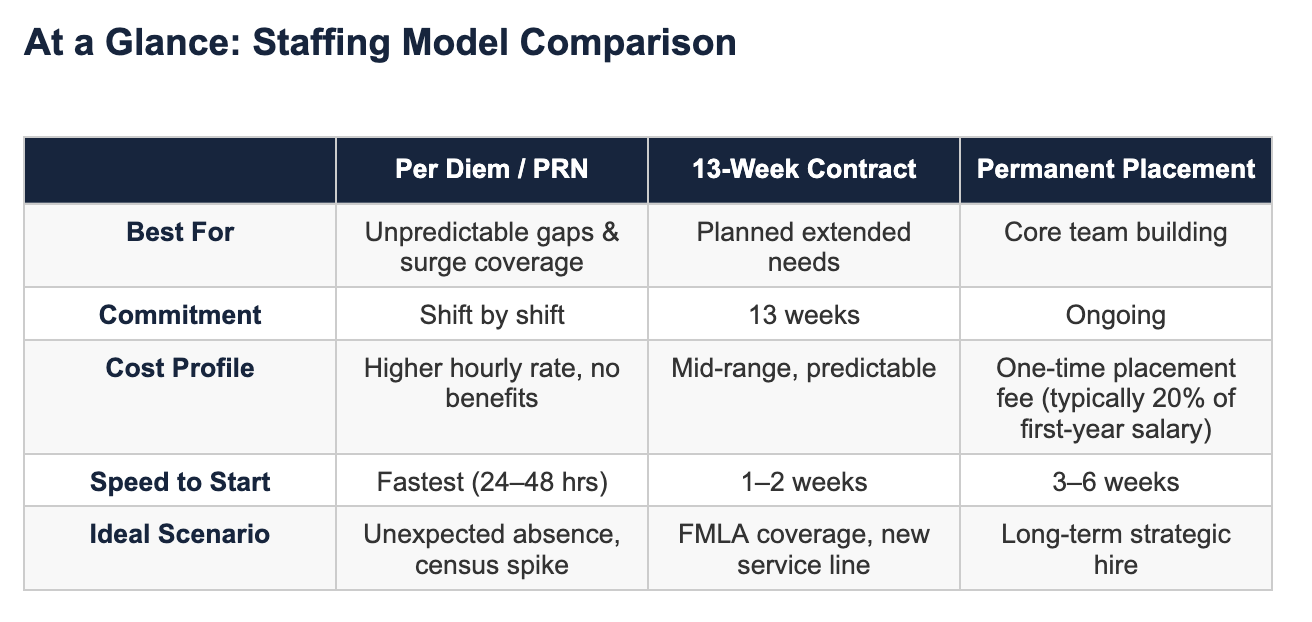
Per diem staffing means you're calling on a clinician to cover specific shifts on an as-needed basis. There's no weekly hour guarantee, no long-term commitment on either side. The clinician shows up when you need them, and the relationship ends when the shift does. Per diem (also referred to as PRN, from the Latin meaning "as needed") is the most flexible model and typically carries the highest hourly bill rate — you're paying a premium for on-demand availability.
13-Week Contract
A 13-week contract is the industry-standard short-term placement — a fixed-term agreement where a clinician commits to a defined schedule at your facility for roughly three months. The timeframe is long enough to get genuine value out of the placement (orientation, learning your workflows, building patient rapport) but short enough to remain flexible. Contracts can often be extended if both parties agree.
Permanent Placement
A permanent placement is a direct hire — the clinician joins your staff as an employee. The agency sources, screens, and presents the candidate; you hire them directly. Agencies typically charge a one-time placement fee, commonly around 20% of the candidate's first-year salary, which replaces the ongoing bill rate. There are no continued agency fees once the hire is made.
Temp-to-Perm Conversion
A temp-to-perm arrangement starts as a contract or per diem placement and transitions to a permanent hire after a defined trial period. Think of it as a working interview — you get to evaluate the clinician in your actual environment before committing. If you convert before the agreed-upon threshold (typically measured in weeks worked or hours logged), a conversion fee applies, which decreases the longer the person has been on assignment.
The Decision Framework: Match the Model to Your Situation
The right model isn't the cheapest option or the most flexible one — it's the one that fits your current operational reality. Here's how to think through it.
Choose Per Diem / PRN when...
You have unpredictable or irregular coverage gaps. A therapist calls out sick. Census spikes unexpectedly on a Monday. A holiday weekend leaves you short. These are per diem scenarios — you need coverage fast, and you can't predict exactly when.
You need someone within 24–48 hours. Per diem placements can move the fastest because the clinician is already credentialed and available to pick up shifts. This is your emergency lever.
Your volume doesn't justify a committed placement. If you only need supplemental coverage a few days a month, locking someone into a 13-week contract doesn't make sense for either party.
The trade-off: You'll pay a premium hourly rate, and continuity isn't guaranteed. If consistency of care matters for a particular patient population, per diem coverage has limits.
Choose a 13-Week Contract when...
You have a predictable, extended gap. A staff member is going on Family and Medical Leave Act (FMLA) leave for 10 weeks. You're opening a new service line and need coverage while you recruit permanently. A known resignation gives you a defined window to fill. These are contract scenarios.
You need someone integrated into your team, not just covering shifts. A 13-week clinician learns your documentation system, your patient population, and your workflows. That operational investment pays off in quality and continuity in a way that per diem coverage simply can't.
You want to evaluate before committing. A 13-week contract is a natural temp-to-perm pipeline. If the clinician is a strong fit, extending or converting is straightforward. If not, you're not locked in.
The trade-off: You're committing to a schedule, which means less day-to-day flexibility than per diem. Bill rates are higher than permanent employment but lower than per diem on an hourly basis.
Choose Permanent Placement when...
You're building or rebuilding your core therapy team. If your staffing instability is structural — not a gap, but a vacancy — permanent placement is the right answer. Filling a permanent role with a permanent hire is almost always less expensive in the long run than continuous contract coverage.
Patient population continuity is a priority. For certain settings and patient types — particularly in skilled nursing facilities (SNFs) and home health — therapist consistency directly impacts outcomes and quality scores. Permanent staff deliver that in a way that rotating contract clinicians cannot.
You're ready to make a hire, not test one. If you have a clear picture of the role, the required skill set, and your compensation range, permanent placement is the most efficient path. A good agency will do the sourcing, screening, and vetting — and you make the hire.
The trade-off: Permanent placements take longer to execute — typically three to six weeks from search to start. And the one-time fee, while often lower than the cumulative cost of extended contract coverage, requires budget planning upfront.
Choose Temp-to-Perm when...
You've been burned by a bad permanent hire before. A temp-to-perm arrangement lets you verify real-world performance, cultural fit, and reliability before making a long-term commitment. The working interview problem is real, and this model solves it.
The right candidate is available now, but you're not ready to commit. Sometimes the timing is imperfect. A strong clinician is available, but you haven't gotten budget approval or HR sign-off for a permanent hire. A short-term contract buys you time without losing the candidate.
The trade-off: Conversion fees apply if you hire before the agreed threshold — typically a sliding scale based on weeks worked. The longer t
The Most Common Mistake Facilities Make
Using a per diem model to solve a permanent problem is one of the most expensive mistakes in healthcare staffing.
A facility that continuously uses per diem coverage to fill what is functionally a full-time vacancy is paying premium hourly rates for inconsistent coverage, absorbing the orientation costs every time a new face walks through the door, and sacrificing the care continuity that affects its quality metrics. Over the course of six months, that's often more expensive than a permanent placement fee would have been on day one.
The inverse is also true: locking into a 13-week contract to cover a two-week gap, or initiating a permanent search for a role you only need seasonally, creates unnecessary cost and commitment.
The right model is the one that matches your actual operational situation — your census patterns, your budget cycle, your existing team, and your timeline.
How a Good Staffing Partner Helps
A staffing agency worth working with doesn't just fill orders — it helps you think through which order to place. That means asking questions about your situation before recommending a model, being transparent about the real cost differences between placement types, and having a candidate pool capable of serving you across all four models depending on what you need.
It also means being honest when a different model would serve you better. If per diem is what you need today, a good partner will tell you that. If that per diem need has quietly become a permanent vacancy, they'll tell you that too.
CoreEthos Group serves SNFs, home health agencies, outpatient clinics, and inpatient rehabilitation facilities (IRFs) across the DC, Maryland, and Virginia region — offering per diem, 13-week contract, permanent placement, and temp-to-perm solutions for physical therapists (PTs), physical therapist assistants (PTAs), and occupational therapists (OTs). We're built to meet you where your facility actually is, not where a standard contract would prefer you to be.
Not sure which model fits your current situation? Let's figure it out together.
